
Start with the date you must be out
An office move has a fixed point that a house move usually does not: the day the lease on the old premises ends, or the day the new one starts costing you money. Everything else is planned backwards from there.
The other constant is downtime. Every hour the business cannot work is a cost that dwarfs the difference between removal quotes, which is why office moves are normally done in the evening, over a weekend, or across a bank holiday.
A workable timeline for a small to medium office:
- Three months out — confirm the new premises, survey both sites, get quotes, order broadband and phone lines
- Two months out — agree the floor plan, decide what is not going, tell staff, book the building access at both ends
- One month out — order crates and labels, confirm the IT plan, arrange disposal and storage
- Two weeks out — staff pack their own desks, archive goes into storage, decommissioning starts
- Move weekend — IT out last, in first; furniture and crates follow
- Monday — trade as normal
If you are moving a business of any size, connectivity is the item to start first. A standard business line can take a couple of weeks; a leased line often takes months, and no amount of goodwill from a removals firm compensates for arriving somewhere with no internet.
Book the buildings, not just the movers
This is the step most first-time office movers miss, and it stops moves dead.
Commercial buildings control access. Depending on the building you may need to book a goods lift, reserve a loading bay, arrange out-of-hours access with security, obtain passes for the crew, and provide the building manager with insurance documentation and risk assessments in advance. Some buildings require notice of a week or more, and some prohibit moves during working hours entirely.
Ask both building managers, early, what they require and how much notice they need. Then tell your removals company, because it determines when they can actually work.
Use crates, not cardboard
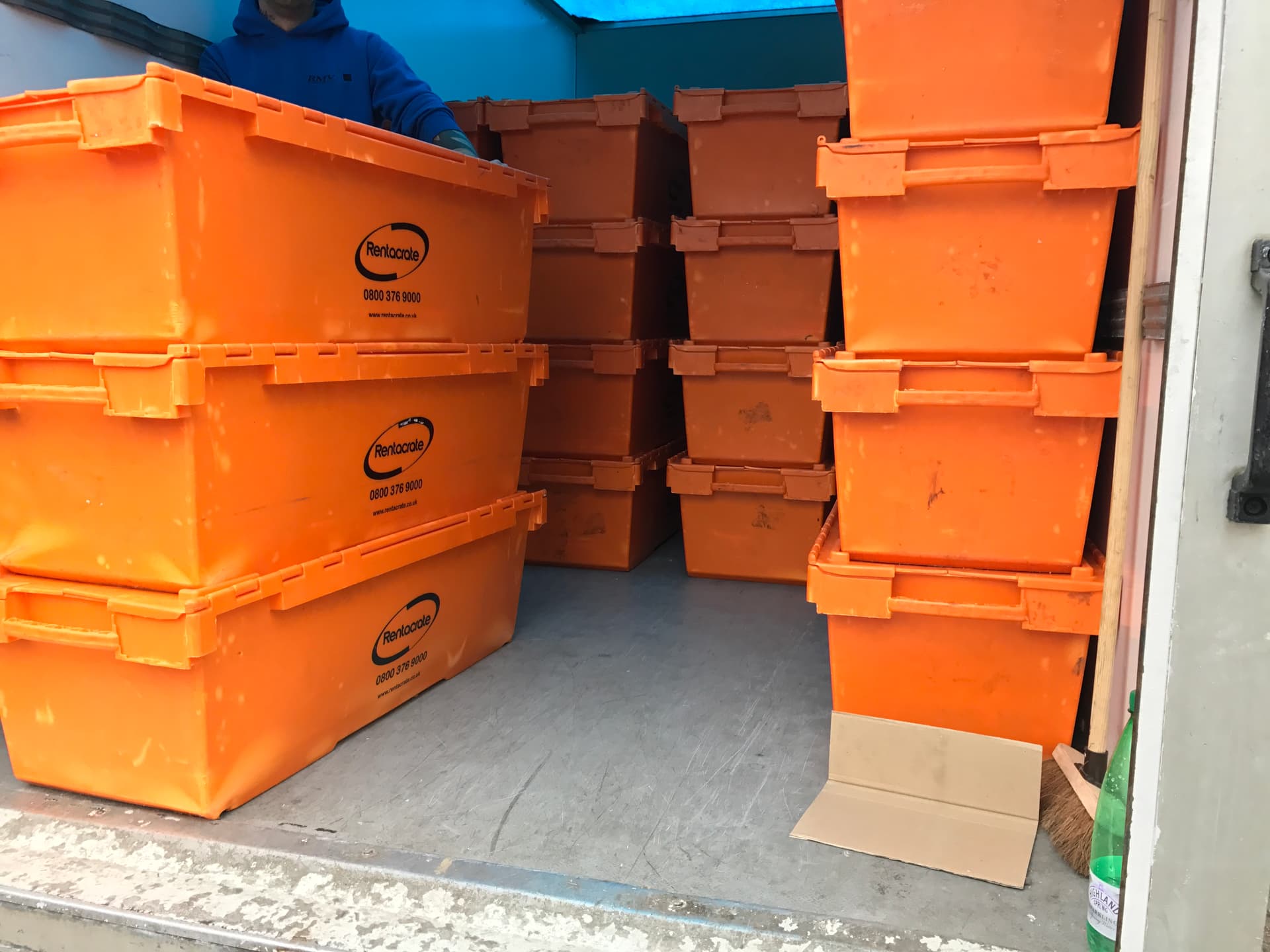
Office moves run on plastic crates rather than boxes, and the difference is not cosmetic.
Crates stack securely on wheeled dollies, so a crew moves twenty at a time instead of carrying them individually. They do not collapse, they lid without tape, and they are returned afterwards rather than becoming a mountain of cardboard in your new reception. Most commercial removals firms hire them by the week.
The system that goes with them matters more than the crates:
- Number every desk at the new site on the floor plan, and put the same number on a label at the new desk position
- Every crate carries the destination number, not the person's name and not the old room
- Colour code by floor or department on top of the numbering
- Staff pack their own desks into their own crates, which is faster and reduces the "where is my stapler" problem on Monday
- Photograph the back of every workstation before anything is unplugged
IT is a separate project
Treat IT as its own workstream running alongside the physical move, sequenced around it.
Out last, in first. The servers, comms cabinet and network need to be live at the new site before desks arrive, not after. If you have on-premises servers, that usually means a specialist decommission and recommission rather than a removals crew unplugging things.
Also worth confirming: the new premises actually has enough power and data points where you intend to put people, that the comms room has adequate cooling, and that Wi-Fi coverage reaches the far corners. These are cheap to fix before a move and disruptive afterwards.
Anything being disposed of needs certified data destruction before it leaves the building, and old hardware must go through WEEE-compliant recycling. A factory reset is not sufficient for machines that held company or client data.
Decide what is not going
Every office move is also a clear-out, and doing that clear-out on move weekend is the expensive way.
Work through it a month ahead: what is coming, what is being archived, what is being disposed of, and what is being sold or donated. Old furniture in reasonable condition is often taken by local charities or reuse schemes rather than costing you disposal fees.
For paperwork, retention rules apply and cannot be shortcut. Our guide to an office clear-out covers what UK businesses are legally required to keep, how long for, and how to dispose of the rest securely.
Anything you must keep but do not need daily belongs in container storage rather than occupying floor space you are paying rent on. Containers are collected from the premises and returned when you need them, which also makes them useful for staging a phased move.
Match the crew to the job
Scale sensibly. A twenty square metre office with six desks does not need a ten-person crew, and a two-hundred square metre floor with forty workstations will not be moved by two people in an evening.
The survey should produce a specific number: crew size, number of vehicles, hours, and how the work is sequenced. If a quote arrives without those numbers, it is a guess.
Involving your own staff is optional and works best when it is limited to their own desks. Asking employees to carry furniture raises questions about insurance and manual handling that are not worth the saving.
The last thing: cleaning both ends
The old premises usually needs a proper clean, both for the lease and for the dilapidations position. The new one is far easier to clean before it fills up with furniture.
Book both, and book the old one for after the van has gone. Our guide to choosing an office cleaning company covers what to specify and which checks to make.
Frequently asked questions
How long does an office move take? Most small to medium moves happen over a single evening or weekend, with planning starting two to three months earlier. The physical move is short; the preparation, IT and building access arrangements are what take time.
Should an office move happen out of hours? Usually, yes. Downtime normally costs more than the additional labour, and many commercial buildings restrict moves during working hours anyway.
What do I need to arrange with the building manager? Goods lift booking, loading bay access, out-of-hours entry, security passes for the crew, and copies of the removal company's insurance and risk assessments. Ask both buildings early, since notice periods vary.
Should we use boxes or crates for an office move? Crates. They stack on dollies so a crew moves many at once, they do not collapse, they need no tape, and they are returned afterwards instead of leaving you with waste cardboard.
How should office crates be labelled? By destination, using a numbered desk plan at the new site rather than people's names or the old room. Colour coding by floor or department on top of the numbering speeds unloading further.
What happens to old IT equipment? Arrange certified data destruction first, then dispose of the hardware through a WEEE-compliant recycler. A factory reset is not adequate for equipment that has held company or personal data.
How we can help
RMV Storage & Removals has relocated London businesses for over fifteen years, including out-of-hours office removals, crate hire, IT and furniture handling, packing materials, professional cleaning and container storage delivered to your premises, across every area we cover including Barnet and North London.
If you are still deciding whether to move at all, our guide to whether your business should move premises covers leases, dilapidations and staff consultation. Otherwise get in touch with your dates and we will plan it around your trading hours.
Written by Riki Migliori, Director at RMV Storage & Removals. Originally published January 2016. Fully reviewed and updated summer 2026.