
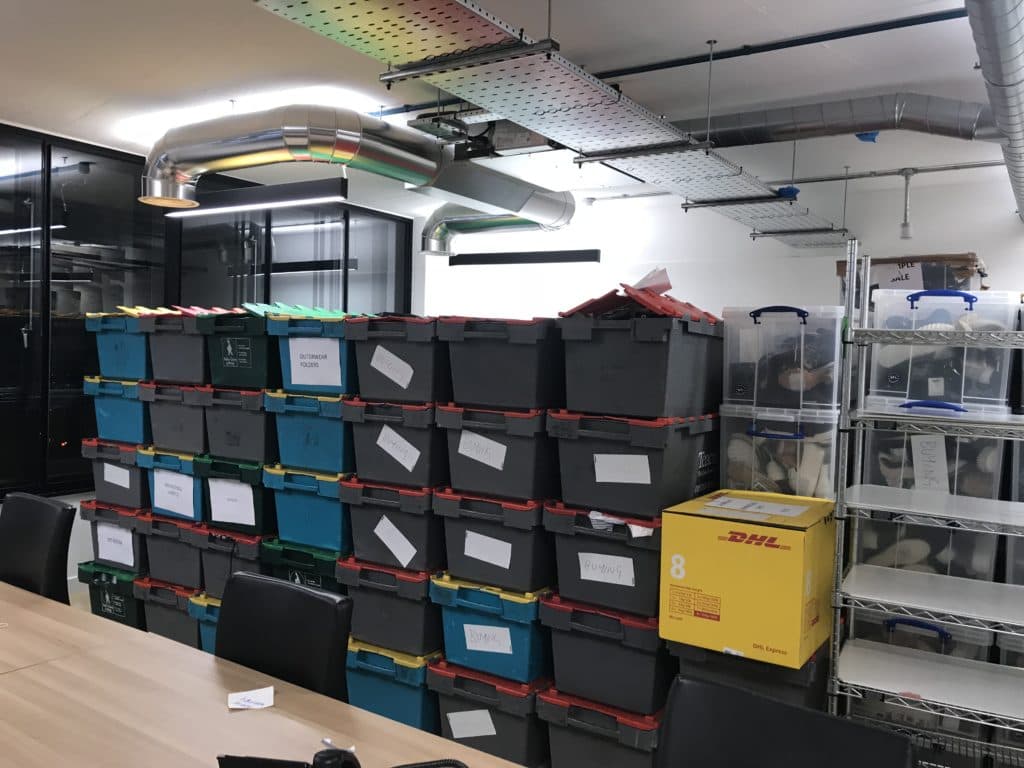
Spring cleaning is something people associate with houses, but an office accumulates far worse. Homes acquire clutter slowly. Offices acquire it in bursts: a project ends and its files stay, someone leaves and their desk contents stay, a laptop is replaced and the old one goes in a cupboard where it remains for four years.
The difference matters because office clutter is not just untidy. It occupies floor space you are paying rent on, it slows people down, and in the case of paperwork it carries legal obligations that a bin bag does not resolve.
Here are five things worth doing, with the UK compliance detail that most versions of this advice leave out.
1. Clear the clutter, and understand why it is hard
Letting go of things is genuinely uncomfortable, and there is research suggesting why. Work at Yale has associated the decision to part with possessions you feel attached to with activity in brain regions also involved in processing pain. Whatever the precise mechanism, the practical observation holds: people put off discarding things, and offices fill up as a result.
There is a cost to leaving it. Research from the Princeton Neuroscience Institute, published in the Journal of Neuroscience, found that multiple stimuli in the visual field compete for neural representation by suppressing one another, which is the mechanism behind the limited capacity of the visual system to process what is in front of it. In an office that shows up as time lost looking for things, work redone because something could not be found, and a general low-level drag on everyone.
The practical approach is to stop treating it as one decision. Go room by room, or desk by desk, and sort into four piles rather than two: keep and use regularly, keep but store elsewhere, digitise, and destroy. Nearly everything belongs in one of the middle two, which is where most people get stuck because they only allow themselves the first and last.
2. Know what you are legally required to keep
This is the part generic office-tidying advice never mentions, and it is the reason a lot of paperwork cannot simply be thrown out.
If you run a limited company, HMRC requires you to keep accounting and company records for at least six years from the end of the financial year they relate to. Some documents, including statutory registers and board minutes, are kept far longer, in some cases for the life of the company.
If you are self-employed or in a partnership, records must be kept for at least five years after the 31 January submission deadline for the relevant tax year.
VAT records are generally six years. Payroll and employment records have their own periods, and minimum wage records must be kept for six years.
Running the other way, data protection law requires that personal data is not kept longer than necessary. HR files, job applications and candidate records should be disposed of once the reason for holding them has passed. So the exercise is not "keep everything to be safe" — it is knowing which category each pile falls into.
Two practical consequences. First, anything containing personal or financial data needs secure destruction rather than the recycling bin, which means a confidential waste service or a cross-cut shredder. Second, everything you must keep but do not need to hand is a candidate for archive storage rather than an expensive filing cabinet in a room you are renting.
3. Send the archive somewhere cheaper than your office
Work out what your office space costs per square foot, then look at how much of it is occupied by boxes nobody has opened this year. In London that arithmetic is usually decisive.
Business and archive storage is designed for exactly this: records you are obliged to retain, seasonal stock, display materials, equipment used a few times a year, furniture left over from a reorganisation. Our containers are collected from your premises and returned when you need them, so nobody spends a morning driving boxes to a depot.
Before anything goes into storage, index it. A box marked "misc 2019" is a box you will never open with confidence again. Number the boxes, keep a list of what is in each, and note anything with a destruction date so you are not storing paperwork a decade after it stopped mattering.
4. Deal with the technology properly
Old hardware. Redundant computers, monitors and phones cannot go in a skip. Under the WEEE regulations, electrical equipment must go through proper recycling channels, and any device that has held company or personal data needs certified data destruction first, not just a factory reset. Many IT disposal firms provide a certificate confirming both.
Live machines. Encourage the team to clear desktops and file into shared storage rather than local drives. A desktop with forty icons is a desktop where nothing is findable, and files that exist only on one laptop are files the business loses when that laptop does.
Digitise what makes sense. Scanning reduces paper volume dramatically, and cloud document tools handle sharing and version control far better than a filing cabinet. Two cautions worth stating: check whether the original of anything you scan must be retained in physical form, since some documents do need the original, and make sure your storage has a genuine backup rather than one copy in one account.
5. Reset the desks
The rule that works is simple: only what gets used through the day stays on the surface. Computer, notebook, pen, whatever you actually reach for. Staplers, tape, spare cables, envelopes and everything else goes in a drawer.
Do it as a team on the same afternoon rather than asking people to get round to it. It takes an hour, it is oddly satisfying, and the effect lasts far longer than an instruction to tidy up would.
While desks are clear, it is the natural moment to clean properly: screens, keyboards, phones, door handles, and the surfaces nobody wipes because they are permanently covered in things.
If the clear-out turns into a move
Sometimes a spring clean makes it obvious that the space itself is the problem: too small, badly laid out, more expensive than it should be for what it delivers.
We handle office removals across London alongside household moves, including out-of-hours relocations so that trading is not interrupted, plus packing materials and storage for anything that will not go straight into the new premises.
Frequently asked questions
How long do UK businesses need to keep records? Limited companies must keep accounting and company records for at least six years from the end of the relevant financial year, with some statutory records kept longer. Sole traders and partnerships keep records for at least five years after the 31 January submission deadline. Both periods are set out on GOV.UK. VAT records are generally six years.
How should confidential business documents be destroyed? Through a confidential waste service or a cross-cut shredder. Anything containing personal or financial data should not go into ordinary recycling, and data protection obligations apply to disposal as much as to storage.
What should I do with old office computers? Arrange certified data destruction, then dispose of the hardware through a WEEE-compliant recycler. A factory reset is not sufficient for equipment that has held company or personal data, and electrical equipment cannot go to landfill.
Is archive storage cheaper than keeping files in the office? Usually, yes, particularly in London. Compare your rent per square foot against the cost of storing the same volume off site. Records you are legally required to keep but rarely consult are the clearest case.
How often should an office be decluttered? A full clear-out once a year is enough for most businesses, ideally aligned with the financial year end so that record retention decisions can be made at the same time. Desk-level tidying works better as a shared habit than an annual event.
What is the first step in an office clear-out? Sort into four categories rather than two: keep to hand, keep but store off site, digitise, and destroy securely. Most items fall into the middle two, which is where people get stuck if they only allow themselves keep or bin.
Talk to us
RMV Storage & Removals has worked with London businesses for over fifteen years, handling office moves, container storage delivered to your premises, archive and document storage, and packing materials, across every area we cover.
Once the space is clear, our guide to choosing an office cleaning company covers what to specify and which checks to make. If a clear-out has turned into something larger, get in touch and we will work out what you actually need.
Written by Riki Migliori, Director at RMV Storage & Removals. Originally published May 2014. Fully reviewed and updated summer 2026.